Field records you can cite — with the consent, the provenance and the retraction attached.
For policy institutes, evaluation teams and evidence units that need operational farm microdata they can defend.
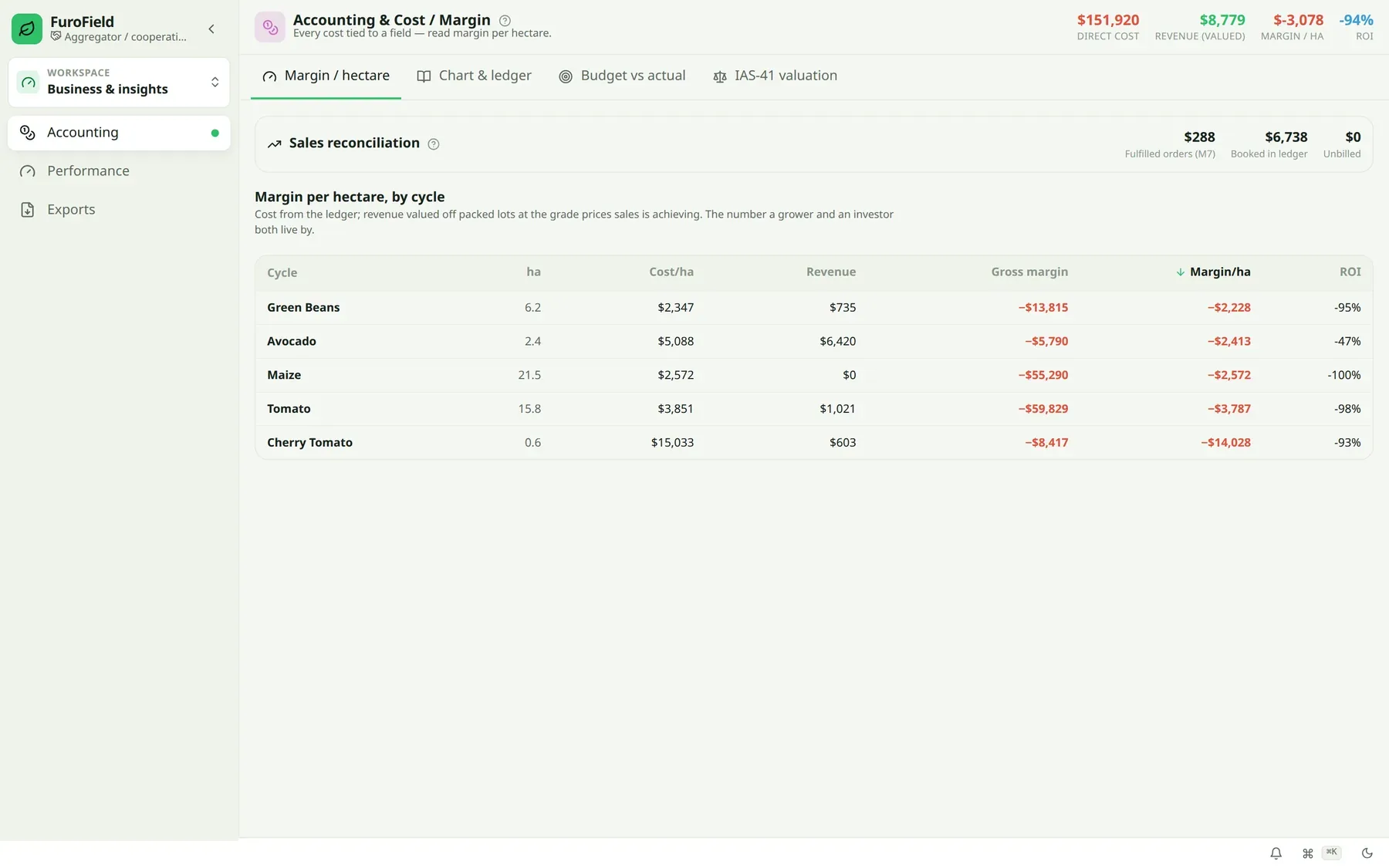
Agricultural research in this region runs on surveys, because the alternative has never been available. A survey is expensive, it is periodic, it is recalled rather than recorded, and by the time it is cleaned the season it describes is two seasons ago. Meanwhile the operational record — what was actually planted, applied, harvested, paid and sold — exists on thousands of farms and is not usable by anyone outside them, because it carries no consent, no provenance and no way to take a participant back out.
FuroField's research spine turns that routine operational capture into a permissioned dataset: a versioned study and protocol, a frozen cohort with immutable hashes, purpose-specific consent that propagates when it is withdrawn, and extracts that are append-only and individually superseded rather than quietly replaced. What a participant agreed to, what the extract contains, and what changed since the last version are all part of the record instead of an email attached to it.
What it deliberately does not do is the analysis. It does not weight, model or estimate, and it will not tell you that a cohort is representative. Those are your judgements and they stay yours — the spine's job is to make the underlying data defensible enough that your judgements can be examined by someone else.
Operational farm data is abundant, and almost none of it is citable
The barrier is not access to records. It is that a record gathered for running a farm carries none of the apparatus a study needs: no purpose-bound consent, no frozen cohort, no version you can point a reviewer at, and no mechanism to remove a participant who changes their mind without silently invalidating everything already published from that extract.
- Consent given once, in general terms, for a purpose nobody wrote down
- No frozen cohort, so the population under study drifts while the study runs
- Extracts shared as files, superseded by other files, with no lineage between them
- Withdrawal handled by deletion — which corrupts the published analysis rather than annotating it
- Identifiers reused across studies, so two datasets can be joined that were never meant to be
From first record to something you can act on
Declare the study and freeze the protocol
Study, design, protocol and variable set are versioned authority records. A protocol cannot be frozen against a source that is custodial or unresolved — the freeze produces a refusal report naming what is missing, rather than a dataset with a quiet hole in it.
Freeze the cohort, then let it move on the record
Membership and intervention definitions are frozen with immutable hashes. Exclusions and assignment deviations are appended as events, never edited in place, so attrition and cohort flow are readable after the fact instead of reconstructed.
Bind consent to the purpose and the version
Consent is specific to a purpose and a protocol version, withdrawal propagates through what depends on it, and the participant gets a receipt. Subject requests are answered with hash-bound downloads. A grower can act on their own behalf, not only through an operator.
Release through gates that refuse rather than degrade
Per-study pseudonyms, a frozen geography and suppression policy, and five executing release gates with expiring grants and logged access. A gate that fails produces a refusal — never a quieter, coarser download that looks like the real one.
In detail
An extract with canonical bytes and a codebook
Append-only versions carrying a manifest, codebook, quality report and hashes, so two people who cite the same version are provably citing the same bytes.
Supersession instead of silent recall
No released file is withdrawn behind your back. A consumer of a superseded version sees that it was superseded, the id that replaces it and the reason — which is what makes a correction publishable rather than embarrassing.
Per-study pseudonyms that do not join
Identifiers are derived per study, so two extracts released to different teams cannot be linked back together by the identifier alone.
Withdrawal that annotates rather than destroys
A participant who withdraws is propagated through what depends on their consent and recorded as an event. The published analysis stays examinable; what changed is legible.
Sampling frame and instruments, frozen and versioned
Frame, members, instrument versions, measurement occasions and assignment provenance are held as records, with attrition and cohort flow append-only.
An access trail on every release
Expiring principal grants and logged access events, so who obtained which version and when is part of the study record rather than a memory of who was emailed.
Built for these operations
About researchers & evaluators
Is this a replacement for our survey instrument?
No, and we would rather say so before you invest time than after. A survey asks questions nobody's operations answer — intent, perception, household composition, recall of a year with no records. This spine supplies the observed operational half: what was planted, applied, harvested, paid and sold, with consent and provenance. It complements an instrument and shortens it; it does not replace the reasons you field one.
Do you do the analysis, or provide weights?
Neither, by design. FuroField records an approved design and releases the data under it; it does not choose an estimator, construct weights, or make a claim about representativeness or causality. Those remain the researcher's responsibility, and a platform that offered them would be asserting authority over findings it has no standing to hold.
How do you handle a participant who withdraws after publication?
Withdrawal propagates through what depends on that consent and is recorded as an event, and the affected extract version is superseded with a stated reason rather than deleted. Deleting it would corrupt the published analysis and hide that anything happened; superseding it lets you issue a correction that a reviewer can follow.
What is not built yet?
The spine reached production in August 2026 and the boundary is published on this page rather than discovered later. Columnar serialisation for the statistical formats and worked adapter proofs for the common analysis environments are not shipped, so an extract arrives in the released canonical form and you convert it. A funded external pilot is the next step and has not run.
Whose data is it?
The producer's. The scheme or farm operates the workspace and the participant holds the consent, which is why withdrawal has to work and why a study cannot freeze against a source it does not properly hold. A dataset a participant cannot leave is not a consented dataset, whatever the paperwork says.
Related
Investors & lenders
For the capital financing African agriculture — and the reporting obligations attached to it.
Aggregators & cooperatives
For organisations coordinating distributed smallholder outgrower schemes.
Commercial growers
For farms running their own land, their own crews and their own margin.
Bring your fields online this season
Start free on up to 25 hectares — no card. Scale by the hectare as your operation grows.