When a crop cycle is two weeks long, the plan is the product.
Seven to twenty-one day cycles, sown in succession on benches, supplying restaurants and retail from the edge of the city.
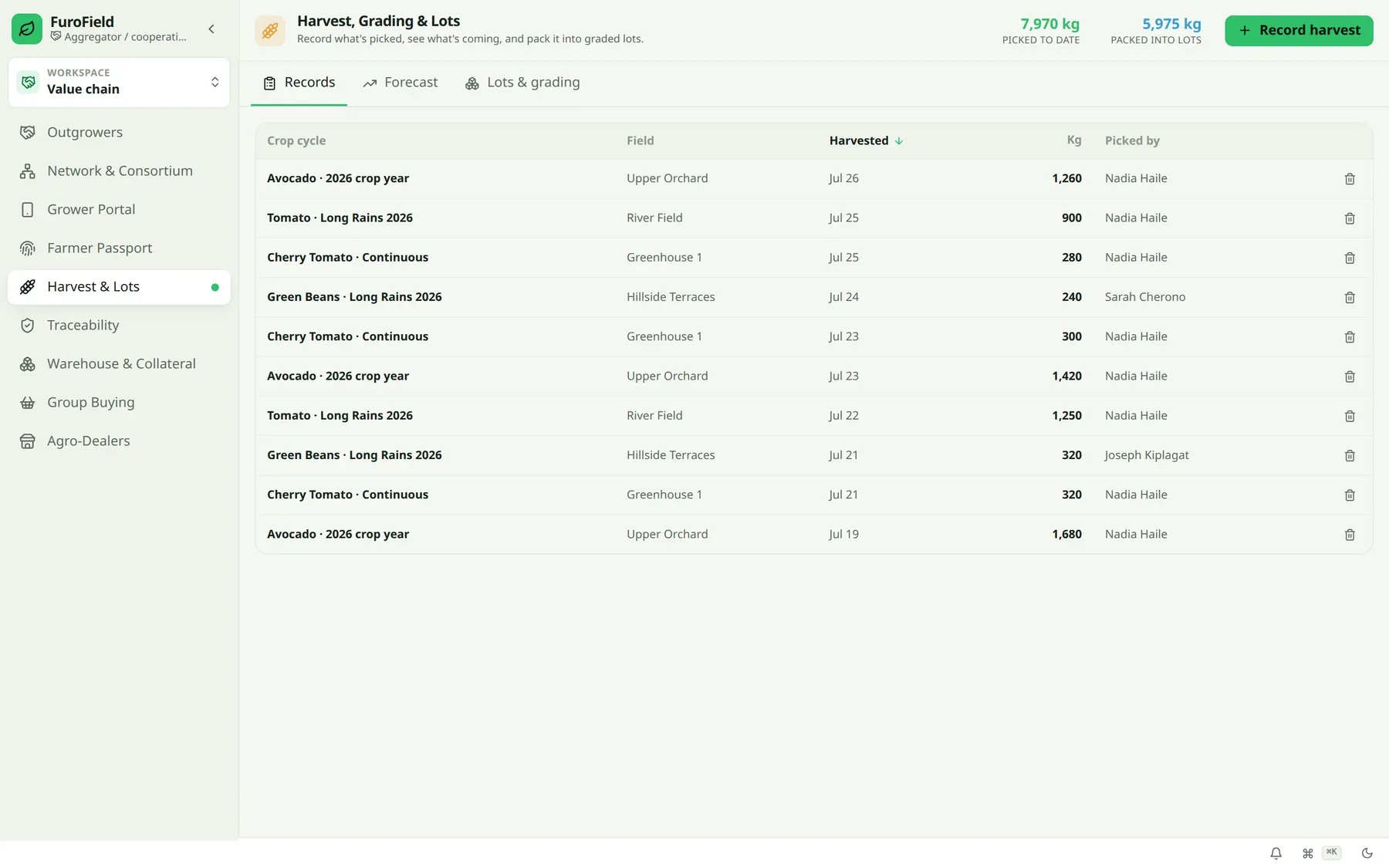
Microgreens and fast-cycle salad leaf run on a rhythm nothing else in agriculture matches. A tray is sown, grown and cut inside three weeks, and the business only works if the next sowing went in before this one came off. Miss a succession and there is a hole in supply a fortnight later that no amount of effort closes.
These operations are usually peri-urban, close to Johannesburg, Nairobi, Kampala or Lagos, selling into restaurants, hotels and specialist retail on standing weekly orders. Margins per square metre are high and so is the cost of a missed delivery. FuroField records benches and grow areas as fields, each sowing as its own crop cycle, and cost per unit of growing area. Structured succession planning is on the roadmap; today the plan is expressed by opening cycles ahead.
Continuous supply is a scheduling problem disguised as a growing problem
The crop itself is straightforward. What breaks these businesses is sowing rhythm and commitment tracking: a chef expects the same quantity every Tuesday, and the sowing that satisfies that expectation had to happen at a specific time with no reminder attached to it.
- Successions tracked in a notebook, so a missed sowing is discovered when the order cannot be filled
- Bench and tray occupancy known only by walking the room
- Cost per tray unknown, so pricing to a restaurant is set by feel rather than by margin
- Standing weekly commitments held in someone's head instead of as a contract with a delivery record
From first record to something you can act on
Set up benches as growing areas
Benches, tunnels or rooms are mapped as fields with derived area, giving you a real denominator for cost and yield per square metre.
Open a cycle per sowing
Every sowing is its own crop cycle with crop, variety, sowing date and target yield. Multiple concurrent cycles on the same bench stay separated, which is what a succession programme requires.
Cost the cycle honestly
Seed, substrate and labour land against the cycle, so cost per tray and per kilogram is computed rather than assumed when you quote a chef.
Sell against standing commitments
Buyers, listings and forward agreements are kept as records, and deliveries settle against what was committed, so a shortfall against a weekly order is visible before the customer notices it.
In detail
Benches and rooms as mapped areas
Growing space recorded with derived area, so output and cost per square metre are real figures instead of estimates.
A cycle per sowing
Short cycles opened and closed continuously, each with its own dates, inputs and yield, and several running on the same bench at once without blurring.
Cost per tray and per kilogram
Seed, substrate and labour costed at the cycle, which is what turns restaurant pricing into a margin decision.
Buyer and contract records
Standing weekly orders held as buyer records and forward commitments, with delivered volume settling against them.
Clean food-safety record-keeping
Where any treatment is applied, the application and its intervals are recorded and enforced — restaurant and retail buyers increasingly ask, and ready-to-eat produce leaves no margin for error.
Succession planning
Structured succession scheduling, where the plan itself generates the next sowing date, is on the roadmap. Today successions are run by opening cycles ahead of time.
Built for these operations
About microgreens & fast-cycle greens
Is there automated succession scheduling?
Not yet. Season planning, including succession sequencing that turns a plan into dated work, is on the roadmap and we label it as planned. What is live is a crop cycle per sowing, which gives you the record; the scheduling layer sits on top of it later.
Our unit is trays, not hectares. Does that work?
Yes. Benches and rooms are mapped as growing areas with derived area, and cost and yield are read per unit of that area. Plans are measured in fields and hectares, which for a small intensive site is a generous allowance.
Do we need traceability for restaurant sales?
Increasingly, yes, particularly for hotels and retail chains with their own supplier standards. The records that support it, growing area, cycle, inputs and any treatment applied, are live now.
Bring your fields online this season
Start free on up to 25 hectares — no card. Scale by the hectare as your operation grows.