The most audited crop in African agriculture deserves the tightest records.
Roses and summer flowers under greenhouse, where stem counts, residue limits and a cold chain decide whether the consignment sells.
Kenya and Ethiopia sit among the largest cut-flower exporters in the world, and the trade runs on a schedule measured in hours. Stems are cut, graded, cooled, trucked to the airport and sold at auction or to a supermarket programme within days. Everything about the operation is compressed, and every consignment carries paperwork obligations that the buyer treats as part of the product.
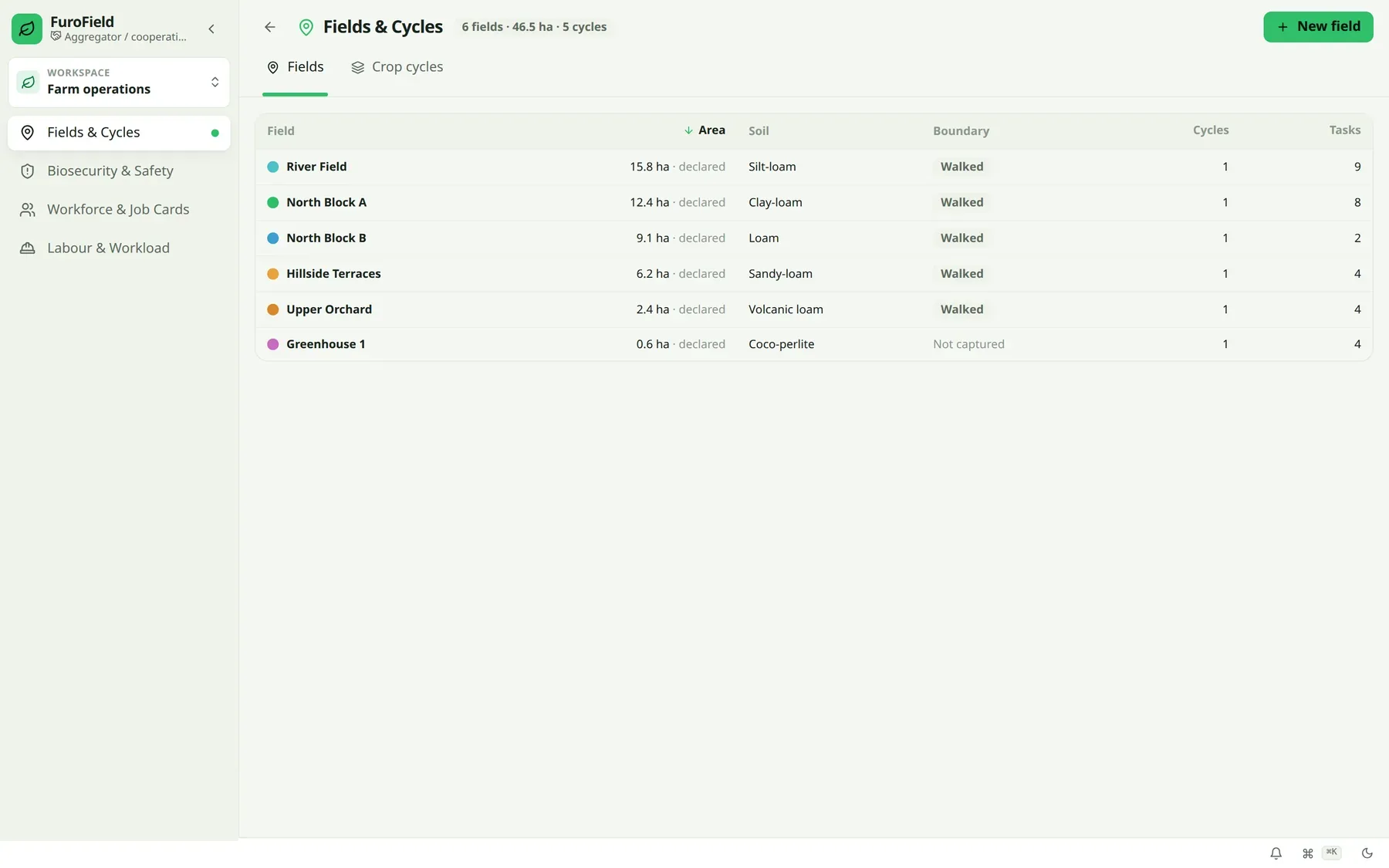
FuroField records greenhouse blocks as mapped units, spray applications with pre-harvest and re-entry controls, scouting for thrips, mites and botrytis, and production-area cost. The shared harvest and graded-lot register is live; flower-specific stem, bunch, vase-life and sensor-backed cold-chain packaging remains planned.
One spray recorded loosely can cost a week's production
Flowers face residue scrutiny that few other African export crops match, because the produce is handled directly by people at the other end and inspected on arrival. The risk is rarely that a farm sprays carelessly. It is that the person cutting at 5am does not know an interval is still running on that bay.
- Withholding periods tracked on a whiteboard, while cutting decisions are made by a different shift
- Scouting for thrips, red spider mite and botrytis logged in books that nobody analyses for a pattern
- No auditable evidence that the interval was observed when an inspection queries a consignment
- Production cost measured per farm, not per bay or variety, so a poorly performing variety is carried indefinitely
From first record to something you can act on
Map greenhouses and bays as blocks
Each greenhouse, tunnel or bay is a mapped field with derived area. Production units become real records rather than names on a plan.
Scout on a proper cadence
Log pest, disease and beneficial observations with severity, incidence percentage and growth stage. Each report stays open with its recommended action until it is resolved, so a recurring thrips pressure reads as a pattern.
Let the intervals hold the block
Record the application with its product, rate and target, and FuroField holds harvest and re-entry on that bay until the pre-harvest and re-entry intervals elapse. A colour-coded view answers what can be cut and entered today.
Cost the production area
Chemical, fertigation and labour costs land against the block, so cost per unit of production area is comparable between varieties and between houses.
In detail
Greenhouse blocks with derived area
Houses, tunnels and bays mapped as fields, with area computed from geometry rather than typed in from a construction drawing.
Enforced pre-harvest intervals
Cutting is held on a treated bay until the interval clears — the single control that stops a residue finding at the destination market.
Re-entry protection for staff
Re-entry is held for the product's interval, which matters most in enclosed greenhouse air where labour density is high.
IPM scouting record
Thrips, mites, botrytis, downy mildew and beneficials logged with severity and incidence, tracked from observation to resolution rather than noted and forgotten.
Nutrient and fertigation programmes
Build feed programmes by growth stage with target rate, unit and method, then mark items applied as the fertigation runs.
Audit evidence from operational records
Applications, intervals and the holds they triggered are kept as record, which is what an inspection or a certification body asks to see. Packaged audit exports for specific schemes are planned.
Built for these operations
About cut flowers
Do you handle stem counts, grading and cold-chain records?
The shared harvest and graded-lot register is live, including a target storage temperature. Flower-specific stem/bunch vocabulary, vase-life controls and sensor-backed cold-chain monitoring remain planned vertical packaging.
Our sprays are decided by an agronomist. Does FuroField replace that?
No. It captures what was observed, what was applied and when the intervals clear, so your agronomist works from a real record instead of a partial one. The recommendations remain theirs.
Can I see which bays are safe to cut before the morning shift starts?
That is the point of the block restriction view. One screen shows every block as clear, in re-entry hold or in pre-harvest hold, so the decision is made from state rather than memory.
Bring your fields online this season
Start free on up to 25 hectares — no card. Scale by the hectare as your operation grows.