Know which hectares pay you — and prove it to everyone who asks.
For farms running their own land, their own crews and their own margin.
A commercial grower carries almost every risk in the chain at once. You buy fertiliser at whatever the season's landed price happens to be, pay a crew every week regardless of what the crop is doing, and sell into a market that pays least exactly when everyone is harvesting. Between those three pressures sits a margin that is usually thinner than anyone outside farming assumes.
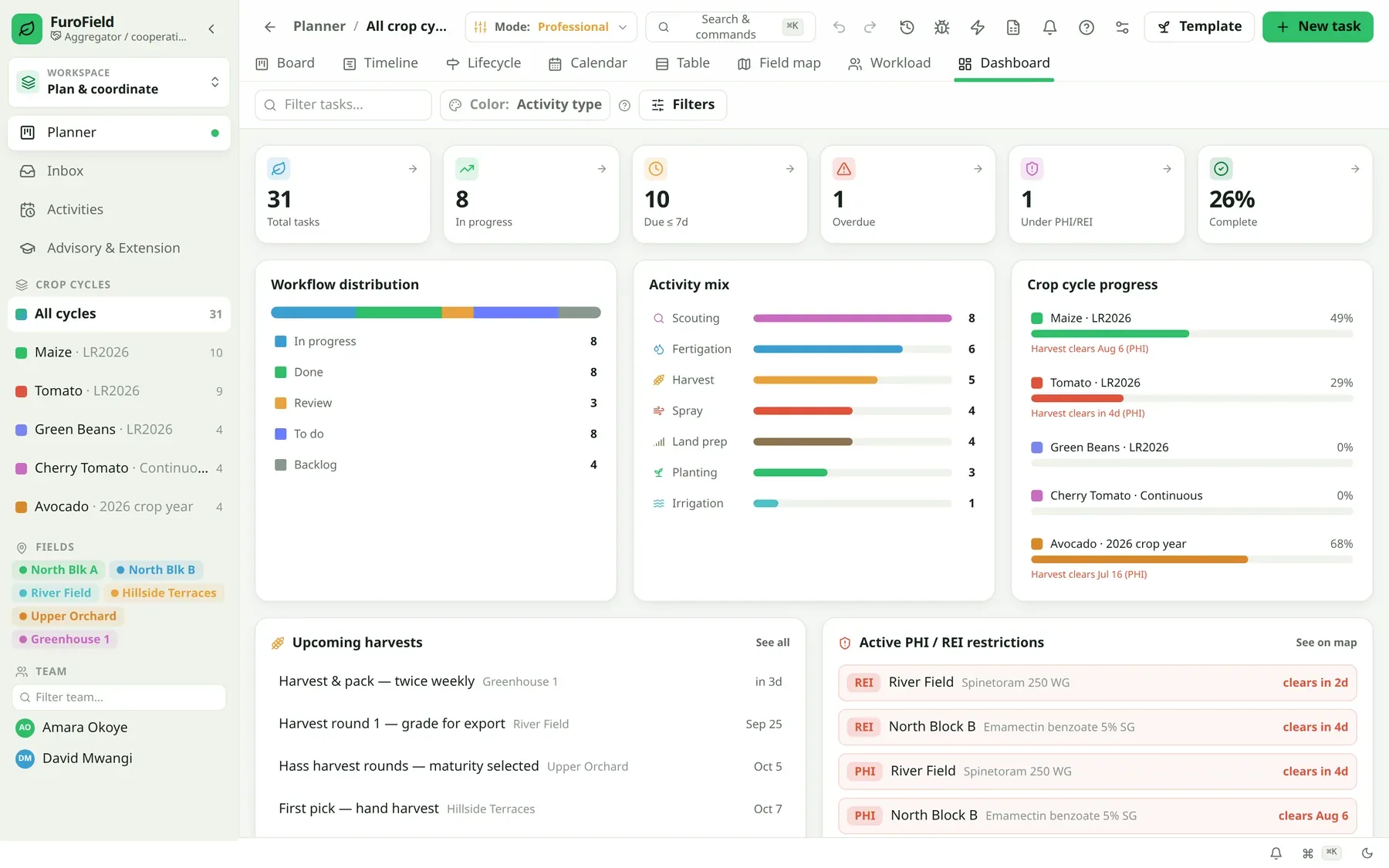
FuroField is built for the way that farm actually runs: boundary-mapped blocks, a crop cycle per planting, sprays that hold harvest until the interval clears, and costs booked against the land that consumed them. The result is not a prettier report. It is knowing, mid-season, which block is carrying the farm and which one is quietly eating it.
The farm makes money; nobody can say which parts of it do
Most growers can tell you last season's bottom line. Far fewer can name the block that lost money three years running, because costs are booked to the business rather than to the hectare — and the buyer paperwork that would settle the argument is spread across a spray book, a weighbridge ledger and someone's phone.
- Input costs pooled at farm level, so no block can be compared with another
- Fertiliser and chemical rates calculated on a remembered area rather than a measured one
- Withholding periods held in one person's head, decided on by someone else at 6am
- Buyer and certifier documentation assembled from scratch, weeks after it was requested
From first record to something you can act on
Map the land you farm
Walk or tap each block's boundary once. Area derives from the polygon, so every rate, yield and cost figure downstream sits on a measured number instead of an inherited guess.
Open a cycle per planting
Each planting gets its own crop cycle with variety, dates and target yield. Successions on the same block stay separate, which is what makes season-on-season comparison possible at all.
Record work where it happens
Scouting reports, applications, nutrient plans and costs are captured against the block by the person doing the work. The local workspace continues without signal; shared reconnect remains pilot-gated.
Read the margin, not the totals
Because costs land on fields and cycles, cost and margin per hectare fall out of ordinary record-keeping. The weak enterprise becomes nameable while there is still a season left to change it.
In detail
Margin per hectare, per block
Cost and return computed against measured area, updated as inputs and deliveries land rather than reconstructed after the season closes.
Enforced harvest and re-entry holds
Record an application and FuroField holds harvest and re-entry on that block until the product's intervals clear. A rejected consignment costs more than a season of record-keeping.
One view of what is safe today
A per-field restriction view answering the two questions that matter at dawn: which blocks can I cut, and which can I send people into.
Contracts instead of gate prices
Buyer directory, forward and offtake contracts, and delivered-versus-committed tracking — so you are not discovering a shortfall on the day the contract falls due.
Documentation that already exists
Boundaries, applications and deliveries captured for operational reasons also serve as buyer and due-diligence evidence. Packaged GAP and GlobalG.A.P. audit exports are planned, not shipped.
Labour and safeguard records
A worker register and a grievance mechanism, live today, which is increasingly what a formal buyer or a lender's E&S team asks for before anything else.
Built for these operations
About commercial growers
We already keep good records. What does this change?
Where they live. A spray book proves nothing at the moment someone decides to harvest, and a costing spreadsheet cannot hold a block boundary. FuroField connects the record to the decision — the interval blocks the harvest, the cost lands on the hectare — which is the part paper cannot do.
Our crew leaders are not office people. Will they use it?
Capture is built for a low-end Android phone in a field with no signal, and it syncs when there is one. The test we hold ourselves to is whether a scouting report or an application takes less time to record than to write down.
Is pricing per user? We have a lot of seasonal staff.
No. Plans are measured in fields and hectares, not seats, precisely because headcount on a farm swings with the season and charging for it would push you towards worse records.
Related
Buyers & exporters
For processors, exporters and retail buyers sourcing from African production.
Aggregators & cooperatives
For organisations coordinating distributed smallholder outgrower schemes.
Input suppliers & distributors
For the distributor, retailer or agency network whose product is advice that ends in a sale — and has to survive an audit.
Bring your fields online this season
Start free on up to 25 hectares — no card. Scale by the hectare as your operation grows.