The layer that turns a grower base into a business.
In African crop production the unit that needs managing is often not a farm — it is a scheme. An aggregator, cooperative or processor coordinating a distributed grower base, financing their inputs, buying their harvest, and answering to a buyer for the result. FuroField is built for that shape.
One cycle, from enrolment to evidence
Each stage produces the record the next stage needs. That is the whole design: nothing has to be re-entered, and by the end of a season the scheme has assembled — as a by-product of operating — exactly what a lender and a buyer want to see.
Register
Growers are enrolled with GPS-mapped plots, household detail and light-touch verification, organised into cooperatives and zones. Local no-signal capture ships; shared reconnect remains a pilot gate.
Finance
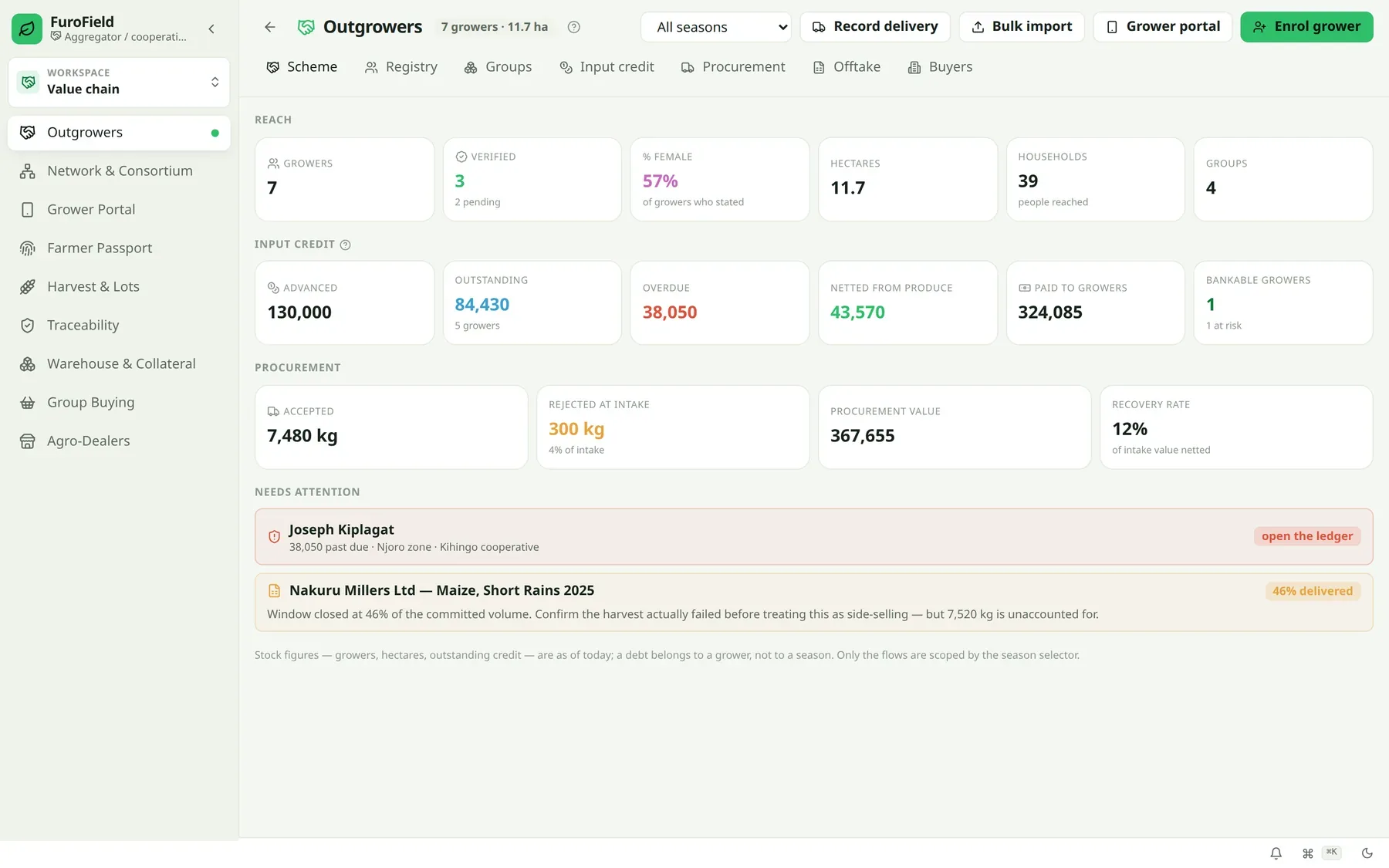
Seed and fertiliser are advanced on credit at planting, because the gap between paying for inputs and earning from harvest is the binding constraint on smallholder yield.
Grow
Agronomy runs on the same platform — scouting, applications with enforced pre-harvest intervals, nutrient plans — so what happened on the plot is recorded, not remembered.
Recover
Deliveries are valued at intake and net automatically against outstanding advances, oldest first. No end-of-season reconciliation, and no disputes without a ledger to settle them.
Sell
Consolidated volume settles against forward and offtake contracts, so a shortfall is visible while there is still season left to act on it.
Prove
The records produced along the way become the evidence a buyer, certifier or lender asks for — traceability to plot, interval compliance, and a repayment history in the grower's name.
The loop starts one stage too late
Registering growers and advancing inputs records capital going out and produce coming back. It never establishes why the capital was safe to deploy in the first place.
A crop season is not yet a financeable transaction. Nobody can prove in advance that the inputs will become a compliant crop, that the crop has a committed buyer, or that the sale proceeds will repay the capital and pay the farmer fairly. That single defect is why a lender’s diligence costs more than the ticket earns, why a buyer cannot rely on the volume, and why an aggregator carries the loss when produce leaves by the gate.
Start from committed demand
A buyer's requirement — crop, grade, volume, delivery window, price formula and what will be rejected — recorded and verified before a single bag of fertiliser goes out. That commitment is the repayment source, and without one an advance is unsecured against anything.
Fund against a plan that reaches it
The commitment becomes hectares, planting windows, an input and labour requirement, a budget and a downside band. Inputs are released only when demand, plan and facility headroom all clear — and a refusal says which of the three failed, and by how much.
Settle in a stated order
Delivery value repays the facility that funded the inputs, then the aggregator's own advances oldest-first and capped at the debt, then the grower's residual — paid promptly, with all three lines on the statement. Agreed at origination, not argued at the weighbridge.
Where this stands today. Offtake contracts, input advances, FIFO netting at delivery, grading at intake and the per-grower ledger are live now. Recording a buyer commitment before inputs go out, the funding gate, the lender settlement waterfall and the portfolio view are in design and named on the roadmap — they are not shipped. We would rather say which half is which.
Six roles, one set of records
Each role sees the chain from a different side. Because they work off the same records, what one produces is what the next one needs.
Commercial growers
For farms running their own land, their own crews and their own margin.
Read moreAggregators & cooperatives
For organisations coordinating distributed smallholder outgrower schemes.
Read moreInvestors & lenders
For the capital financing African agriculture — and the reporting obligations attached to it.
Read moreBuyers & exporters
For processors, exporters and retail buyers sourcing from African production.
Read moreInput suppliers & distributors
For the distributor, retailer or agency network whose product is advice that ends in a sale — and has to survive an audit.
Read moreResearchers & evaluators
For policy institutes, evaluation teams and evidence units that need operational farm microdata they can defend.
Read more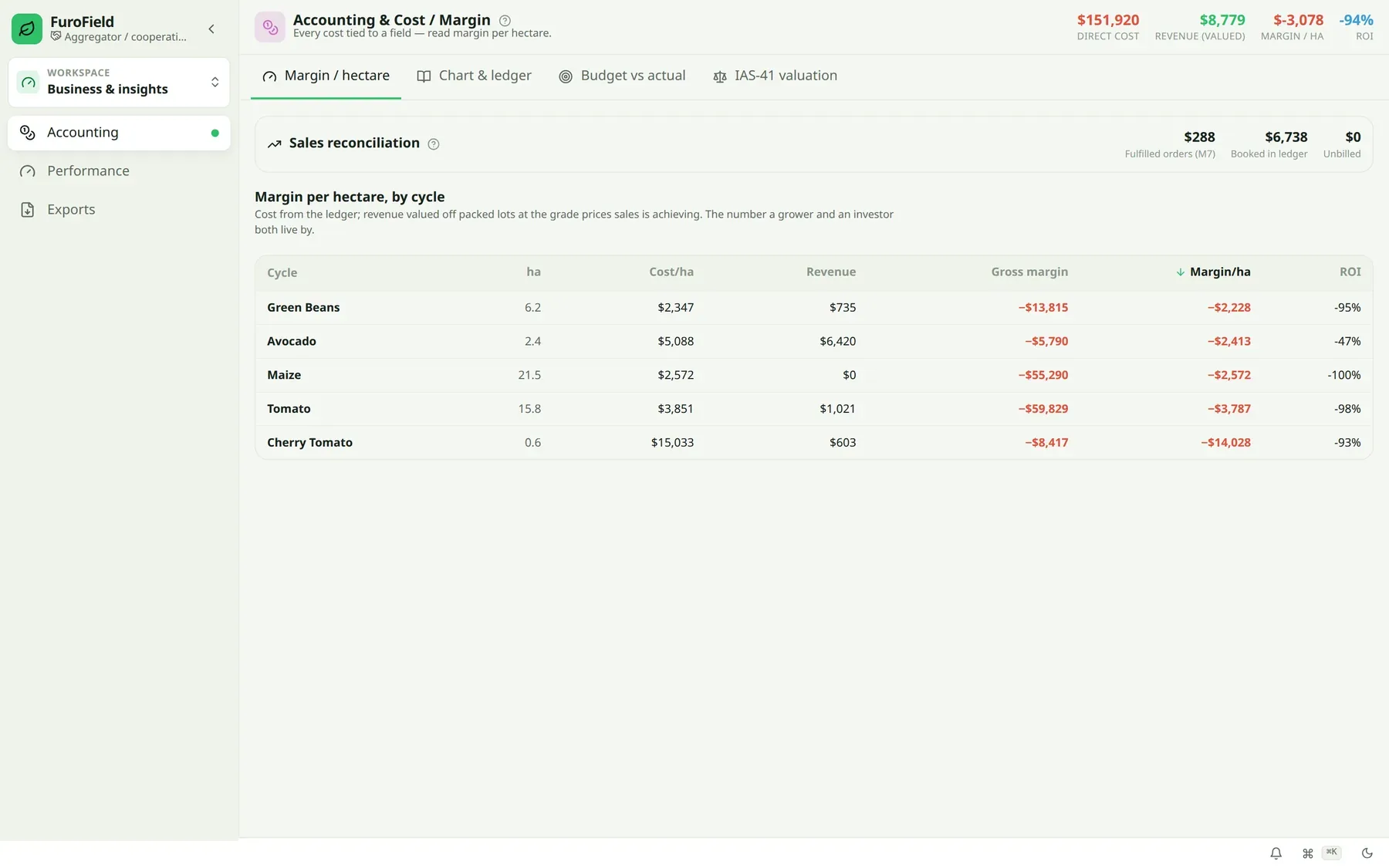
A season of records is the cheapest credit history there is.
There is appetite to finance African agriculture. What is missing is the borrower record — no collateral, no repayment history, no verified identity, no mapped plot, and due diligence that costs more than the loan. Advances issued and recovered through one system produce that record without anyone setting out to.
We are careful about the next claim, though: a repayment history on its own does not open a credit line. Lenders discount a score they cannot trace. What underwrites a season is the history together with a committed buyer, crop economics that hold on the downside, monitoring while the crop is still in the ground, and a recovery order agreed before the money moves.
- Per-grower ledger of advances, deliveries and repayments
- Automatic FIFO netting — transparent and identical for every grower
- Mapped plots that support deforestation due-diligence
- Environmental and social safeguard registers built in
Scope your programme with us
Enterprise plans are built around your cohort size, regions and financing model. Let's map it together.