The crops that feed the continent, recorded hectare by hectare.
Maize, wheat, soya, beans and sorghum — from broad-acre commercial blocks to distributed smallholder plots.
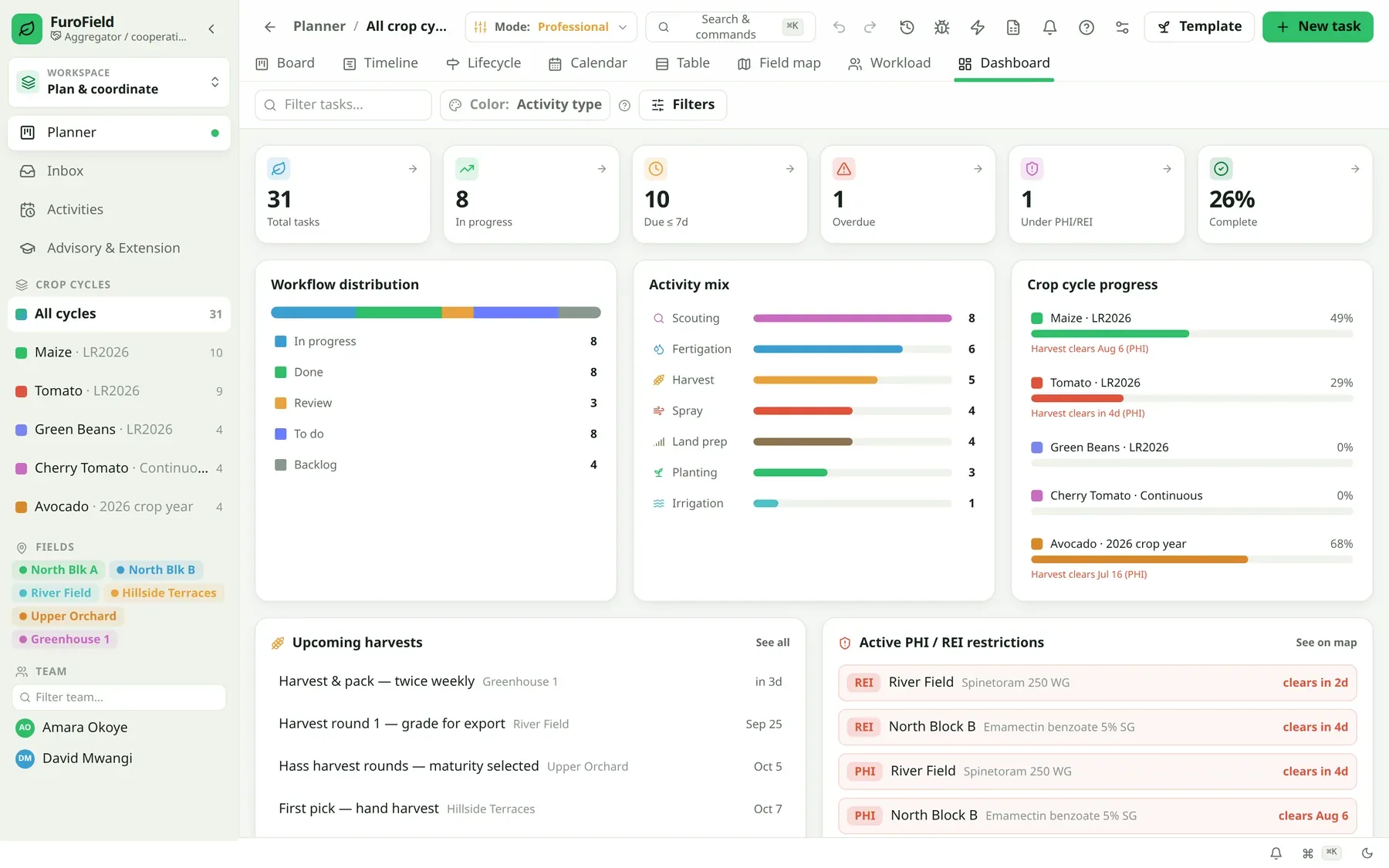
Field crops are where most African farming actually happens, and where the record-keeping is thinnest. A commercial maize block and a half-hectare smallholder plot face the same arithmetic: seed and fertiliser are bought at planting, at a price nobody controls, and repaid by a harvest that is months away and weather-dependent. The margin lives in the gap between those two numbers.
FuroField handles both ends of that spectrum on the same records. Boundaries give you real hectares instead of remembered ones, crop cycles keep each planting separate, and costs land against the block that consumed them. For aggregators, the same field data sits under the outgrower registry, so a scheme's plots are mapped rather than described by landmark.
Per-hectare economics are the whole game, and almost nobody can state them
Field crops run on thin margins across large areas, so a small error in area or input rate compounds into a real loss. Yet the area is usually a figure someone inherited, the fertiliser rate was calculated against it, and the yield comparison between two blocks is not comparable at all.
- Fertiliser and seed rates set against a remembered hectarage rather than a measured boundary
- Yield reported per farm, so a consistently weak block goes unnoticed for years
- Input costs pooled into one seasonal figure with no link to the block that consumed them
- Smallholder plots in a scheme described by landmark, which makes traceability and credit recovery guesswork
From first record to something you can act on
Map the block or plot
Walk the perimeter, tap the corners or import an existing polygon. Area derives from captured geometry and retains its capture source, so a measured boundary is not confused with a declared estimate.
Open a cycle per planting
Each planting gets its own crop cycle with crop, variety, planting date and target yield. A main crop and a late succession on the same land stay cleanly separated.
Record inputs where they are used
Fertiliser, seed and chemical costs are booked against the field and the cycle. Sprays carry their pre-harvest and re-entry intervals, which hold harvest and re-entry on that block automatically.
Read the block, not the farm
Cost per hectare and margin per hectare compute per block and per cycle, which is the level at which rotation and enterprise decisions are actually made.
In detail
Measured hectares, not estimated ones
Boundaries stored as geometry with area derived from them, plus a provenance flag showing whether a block was walked, tapped or imported.
Per-planting crop cycles
Crop, variety, dates, growth stage and target yield on every planting, so two crops on one field in a season never blur together.
Cost and margin per hectare
Inputs costed at the point of application, so the weakest block in a rotation can be named instead of suspected.
Spray holds that block harvest
Applications record their pre-harvest and re-entry intervals and hold the block until those intervals clear — which matters as soon as you sell into a formal buyer or a grain trader with residue testing.
Smallholder plots in the same model
Outgrower plots are mapped and registered with the same field records. Enterprise pilots verify representative scale and device behaviour before rollout.
Input credit that recovers itself
Where seed and fertiliser are advanced to growers, delivery value nets against the advance automatically, oldest first, rather than being reconciled by hand at season end.
Built for these operations
About field crops
We run a scheme with several thousand maize growers. Does this scale to that?
The hierarchy is designed for that operating shape, with cooperatives, zones and routes and agent-led enrolment. We treat thousand-grower performance, low-end device behaviour and reconnect conflicts as pilot acceptance tests, not as claims proven by a small demo dataset.
Can I plan a full rotation across seasons?
Not yet as a planning tool. Crop cycles, costs and per-hectare results are live today and give you the history a rotation decision needs; multi-season season planning is on the roadmap and we label it as planned.
What about a block that is planted twice in one year?
Each planting is its own cycle on the same field, with its own inputs, sprays and yield. The land is shared; the economics are kept apart.
Bring your fields online this season
Start free on up to 25 hectares — no card. Scale by the hectare as your operation grows.