A farmer registry built for schemes with more growers than staff.
Register and organise a distributed smallholder scheme from one console.
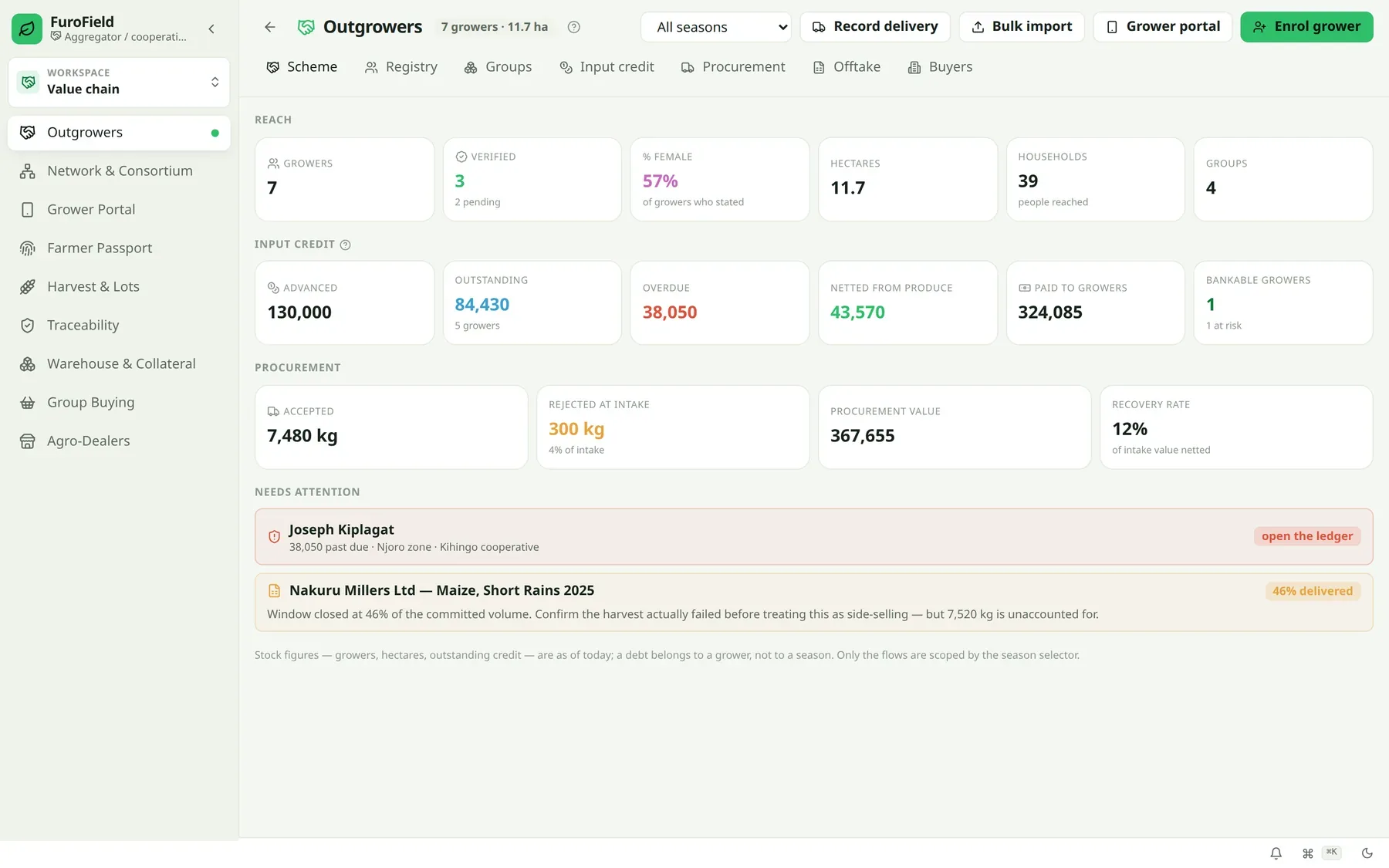
An aggregator's most valuable asset is its grower base, and it is usually its worst-recorded one — spread across field agents' notebooks, WhatsApp groups and a spreadsheet that only one person can safely edit. When a buyer, a lender or a certifier asks who exactly is in the scheme, the answer takes weeks to assemble.
FuroField makes the grower a first-class record: identity, GPS-mapped plot, household detail and a light-touch verification ladder, organised into the cooperatives, zones and routes your field teams actually work in.
You cannot finance, certify or trace a grower base you can't enumerate
Input credit needs a borrower record. Traceability needs a plot. Certification needs a verified identity. A scheme held in notebooks can't supply any of them at the moment they're demanded.
- No single, current list of who is actually in the scheme this season
- Plots described by landmark rather than mapped, so traceability stops at the depot
- Duplicate and ghost growers that inflate input distribution
- Field agents enrolling on paper, with weeks of lag before anyone else can see it
From first record to something you can act on
Enrol the grower
A field agent captures identity, household detail and national ID where required. The local workspace can continue without signal; shared reconnect and conflict handling remain a pilot acceptance gate.
Map the plot
The grower's plot is captured with GPS and area, which is what later makes traceability and deforestation due-diligence possible at all.
Verify to the level you need
Growers move along a light-touch KYC ladder — unverified, pending, verified — so a scheme can start enrolling immediately and tighten verification where credit or certification demands it.
Organise into groups
Place growers into cooperatives, associations, villages, zones or routes. The hierarchy is self-referencing, so it maps onto how your field teams are actually organised.
In detail
Farmer master record
A referenced grower record carrying identity, GPS plot, area, household size and national ID — the spine every other value-chain function hangs off.
KYC-lite verification ladder
Unverified → pending → verified, so enrolment is never blocked but credit and certification can demand a higher bar.
Cooperative & group hierarchy
Self-referencing groups — cooperative, association, village, zone, route — matching real field organisation rather than a flat list.
Low-connectivity field capture
The app shell and local workspace continue without signal. Production pilots explicitly validate reconnect, conflict and device-storage behaviour before promising multi-day sync.
Deduplication by reference
Every grower carries a unique reference, so the same person doesn't quietly appear three times across three agents.
Scheme-level view
Grower counts, verification status and group breakdown for the whole scheme, current rather than reconstructed.
Built for these operations
About outgrower registry
Are outgrowers separate users of the platform?
No. Growers are records the aggregator owns and manages — they don't need accounts, phones or logins. That's deliberate: a scheme shouldn't depend on every smallholder having a smartphone.
How many growers can a scheme hold?
The registry model and hierarchy are designed for large schemes, but thousand-grower performance is a pilot acceptance gate rather than an untested public guarantee. Enterprise scope includes representative data and device testing.
What if a grower has more than one plot?
Plots are recorded against the grower, so multiple parcels are handled without inventing duplicate grower records.
Related
Bring your fields online this season
Start free on up to 25 hectares — no card. Scale by the hectare as your operation grows.