A tree you plant this year is a cost you carry for five and an asset for twenty.
Citrus, avocado, mango and macadamia — perennial blocks where this year's decisions are paid for over a decade.
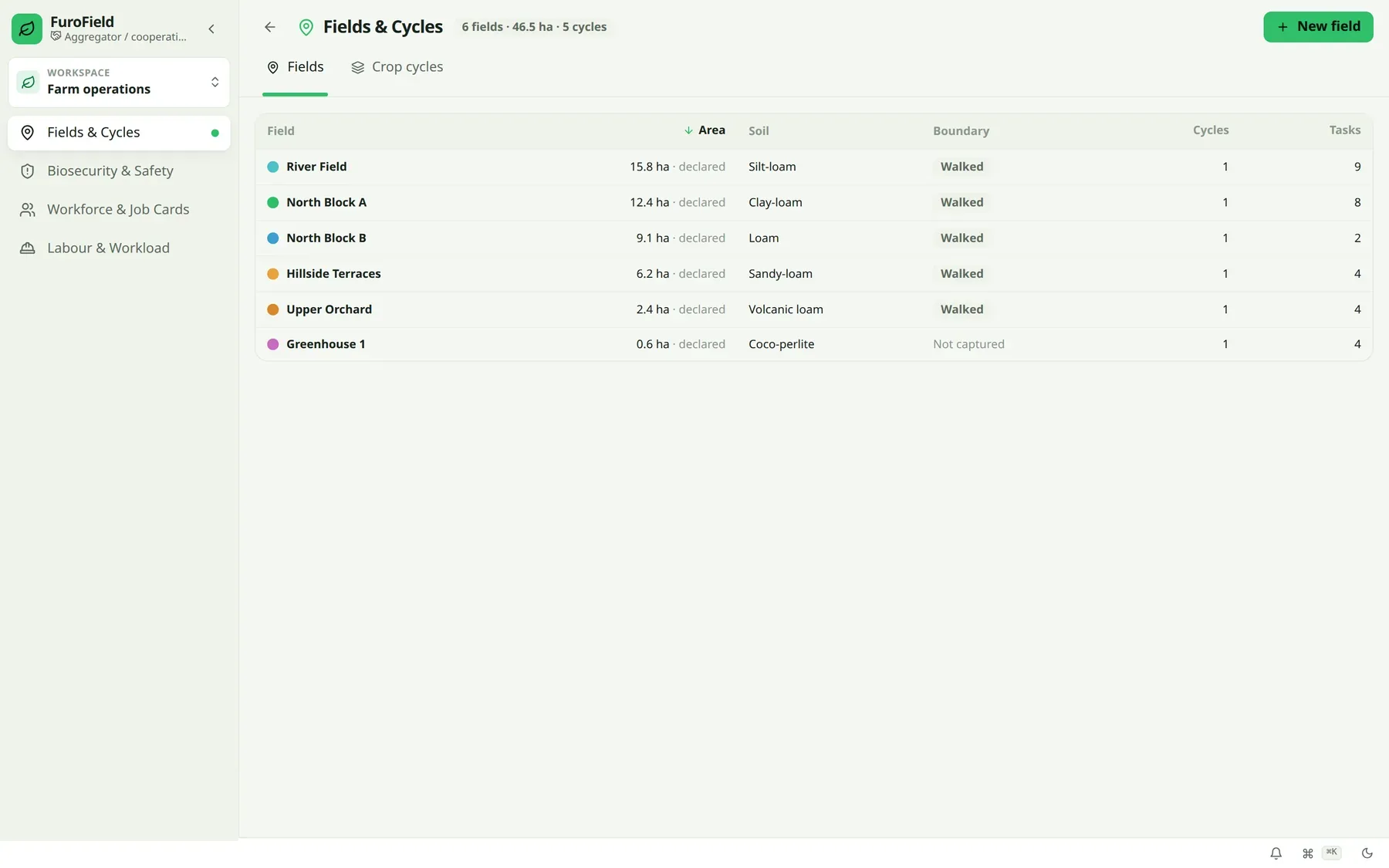
Orchards break the mental model most farm records are built around. There is no replanting each season, so the annual cycle is not the unit of account. Money goes into a block for three to five years before it returns anything, and the block then produces for two decades. Get the establishment record wrong and you have no basis to judge whether the investment is performing.
FuroField gives a perennial block one durable identity and links it to the same field, crop-year, agronomy, harvest, lot and ledger records used elsewhere. Cultivar, rootstock, establishment date, tree census, replacements and observed phenology stay on the block; harvest rounds and economics are derived from the shared operating record rather than copied into an orchard-only ledger.
Annual accounting cannot describe a fifteen-year asset
Books that close each season treat an orchard's establishment years as pure loss and its bearing years as pure gain, which tells you nothing about whether the block was a good decision. Meanwhile the operational detail that would answer it, tree counts, replacements, block-level yield, is usually not kept at block level at all.
- Establishment cost never accumulated against the block, so payback is unknowable
- Tree numbers estimated rather than counted, making yield per tree a fiction
- Yield recorded for the whole orchard, so a declining block hides behind a strong one
- Spray programmes on export citrus or avocado tracked separately from the harvest decision they constrain
From first record to something you can act on
Establish one canonical block
Link the persistent tree-block asset to its mapped field and record species, cultivar, rootstock and establishment date once. Every crop year, task, spray, harvest and cost then reaches the same block through that link.
Observe the trees, not just the calendar
Record flowering, fruit set, growth, maturity and harvest observations against the relevant crop year while planned phase dates stay on the shared cycle.
Count mortality and replacements
Dated censuses separate standing, bearing, juvenile and missing trees and retain replacement history, so today's survival percentage never erases last year's loss.
Close the operating and financial loop
Multiple harvest rounds enter the shared harvest register; packhouse lots, cycle-linked costs and achieved prices roll into picked kilograms per tree, cost and gross margin for the block.
In detail
A persistent orchard identity
Species, cultivar, rootstock, establishment date, field link, tree count and crop-year history stay together instead of being recreated every season.
Tree census and replacement history
Standing, bearing, juvenile, dead or missing and replanted trees are kept as dated censuses, with optional GPS records and health per individual tree.
Observed phenology
Actual flowering, fruit set, fruit growth, maturity and harvest observations sit beside the planned crop-year phases, linked to who observed them and when.
Export spray discipline
Pre-harvest and re-entry intervals enforced per block, with the applications and holds retained as evidence for buyers and inspectors.
Scouting for perennial pests
False codling moth, fruit fly, phytophthora and mite observations logged with severity and incidence against growth stage, tracked to resolution.
Harvest rounds and block economics
Multiple picks use the canonical harvest register, trace into graded lots, and roll up with cycle-linked ledger costs into kilograms per tree and multi-year margin.
Built for these operations
About orchards
Is there a tree census with individual tree records?
Yes in the workspace. Dated censuses preserve standing, bearing, juvenile, missing and replacement counts; selected trees can also carry a GPS fix, tag, planting date, health and note. The block remains the planning and finance unit, so per-tree detail does not fragment the operating spine.
How do you handle a block that is picked five times in a season?
Each pick is a harvest record tied to the block's field and crop year. Those records can feed graded packhouse lots, so the orchard view reads the same chain of custody rather than maintaining a second harvest list.
Can I show a lender the return on a block I planted four years ago?
Yes, with an evidence boundary. Establishment cost, cycle-linked expenses, priced pack-out and biological valuation roll up on the block. The result is only as complete as the costs and sales recorded, and the workspace does not present missing records as zero-risk evidence.
Related
Vineyards
Table and wine grapes, where the block is the row, the calendar is phenology, and the spray programme is relentless.
Field crops
Maize, wheat, soya, beans and sorghum — from broad-acre commercial blocks to distributed smallholder plots.
Nurseries & propagation
Seedlings and young plants raised as batches and sold as plants, supplying every other crop system on this list.
Bring your fields online this season
Start free on up to 25 hectares — no card. Scale by the hectare as your operation grows.