Source from suppliers who can already produce the evidence.
For processors, exporters and retail buyers sourcing from African production.
Buying from African production has always been a reliability problem — volume that moves with the rain, grade that moves with the crew, and a harvest peak when every trader in the district is bidding for the same tonnes you contracted for months ago. What has changed is that the documentary requirement now bites as hard as the supply one.
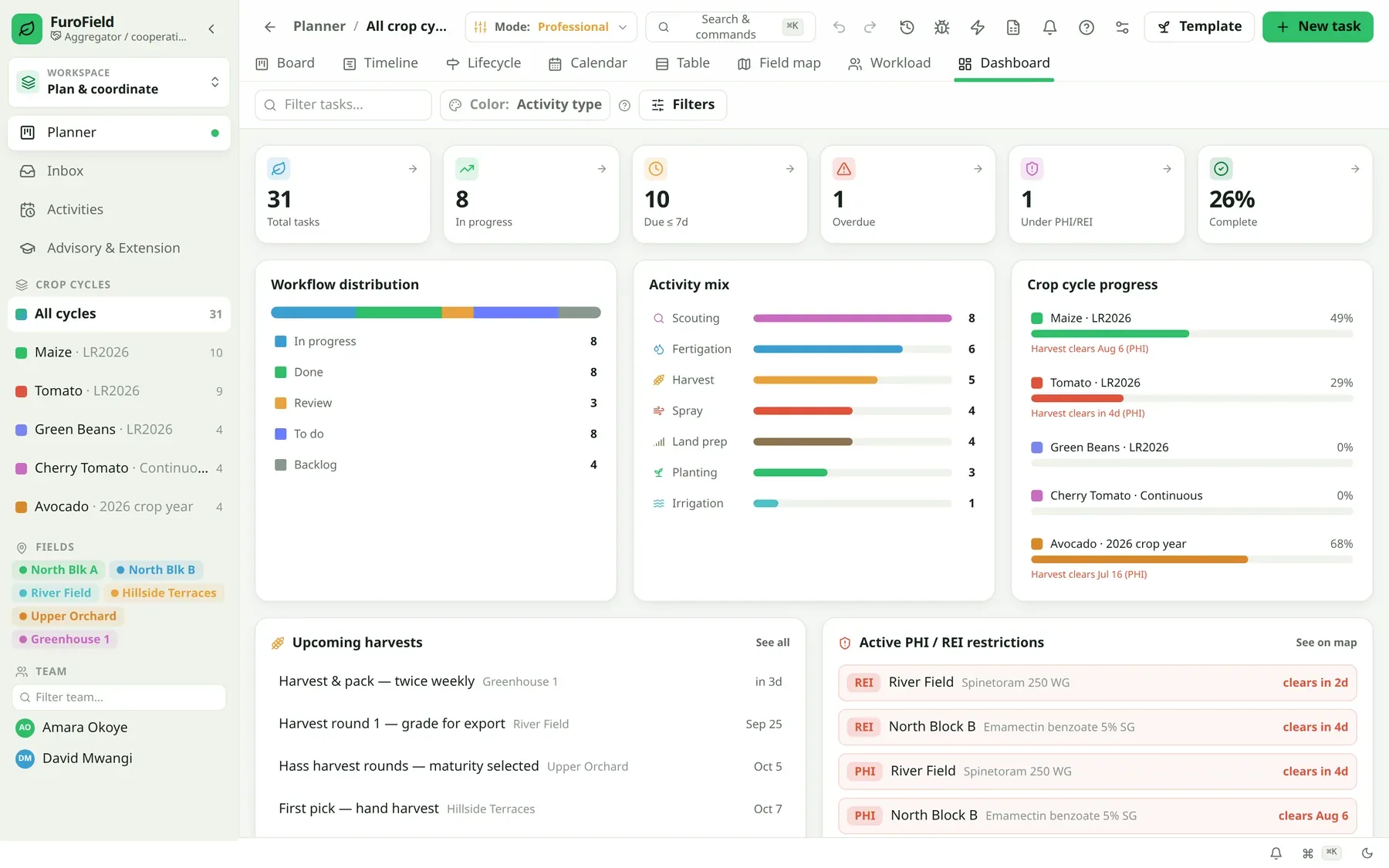
Deforestation due-diligence obligations, residue limits and good-agricultural-practice certification all demand evidence that reaches back to a specific plot and a specific application. Most of your suppliers keep records; very few keep them in a shape anyone can audit. FuroField sits on the supply side and builds that shape out of daily operational capture.
The evidence you need is generated by people who do not work for you
You can specify a documentary requirement in a contract, but you cannot make a supplier's spray book auditable or reconstruct a plot boundary that was never mapped. When the requirement lands, the burden falls back on your own procurement team to chase paperwork through a chain that was never designed to produce it.
- Volume commitments undermined by side-selling at the harvest-price peak
- Grade consistency that varies by crew and by delivery with nothing to trace it to
- Residue and withholding-period compliance asserted by the supplier, not evidenced
- Deforestation due-diligence demanding plot geometry that was never captured
From first record to something you can act on
Contract against a record
Forward and offtake contracts hold committed volume and price on the supply side, and deliveries settle against them — so the fulfilment position is visible to your supplier long before it becomes your problem.
Source from mapped plots
Grower plots are GPS-captured at enrolment and farm blocks are boundary-mapped. That geometry is the precondition for any land-use or deforestation due-diligence question you will be asked.
Inherit the agronomic record
Applications are recorded with their pre-harvest and re-entry intervals, and harvest is held on treated blocks until the interval clears. Interval compliance becomes an operational fact rather than a supplier assurance.
Take evidence, not promises
Traceability foundations connect what you receive back to the field and grower it came from. Packaged GAP and GlobalG.A.P. audit exports are planned; the underlying records that feed them are live today.
In detail
Suppliers with enumerable production bases
An aggregator running FuroField can tell you who is in the scheme, where their plots are and what was applied — in days rather than the fortnight it usually takes.
Plot geometry for deforestation due-diligence
Boundaries and grower plots stored as geometry with a record of how they were captured, so survey-grade plots are distinguishable from estimated ones.
Evidenced withholding periods
Applications carry their intervals and the holds they triggered — an auditable trail behind a residue claim instead of a signature on a declaration.
Traceability back to block and grower
The link from delivery to field and grower is preserved rather than lost at the depot, which is what makes a recall or an origin query answerable.
Earlier warning on shortfall
Delivered-versus-committed tracking on the supply side means a gap is a conversation in week six, not a surprise in week twelve.
Social safeguard records
Worker registers and a grievance mechanism at supplier level — live capability, and increasingly the first thing a retail buyer's compliance team asks about.
Built for these operations
About buyers & exporters
Do we have to run FuroField to benefit from it?
No. The platform is operated by your suppliers — growers and aggregators — and the evidence is theirs to share. Buyers typically arrive because a supplier can already answer questions others cannot, then encourage the rest of the supply base towards the same standard.
Can you certify our supply chain?
No, and be wary of anyone who says they can. Certification is done by certification bodies. FuroField keeps the operating records those bodies and your own due diligence draw on; packaged audit exports for specific schemes are on the roadmap.
Our suppliers are smallholders with no formal systems. Is this realistic?
That is the operating model: the aggregator's field agents capture on growers' behalf. The local workspace can work without signal; the production pilot validates the actual Android devices, reconnect routes and evidence-sharing process before rollout.
Related
Aggregators & cooperatives
For organisations coordinating distributed smallholder outgrower schemes.
Commercial growers
For farms running their own land, their own crews and their own margin.
Investors & lenders
For the capital financing African agriculture — and the reporting obligations attached to it.
Bring your fields online this season
Start free on up to 25 hectares — no card. Scale by the hectare as your operation grows.