Run the scheme from a register, not from thirty field agents' notebooks.
For organisations coordinating distributed smallholder outgrower schemes.
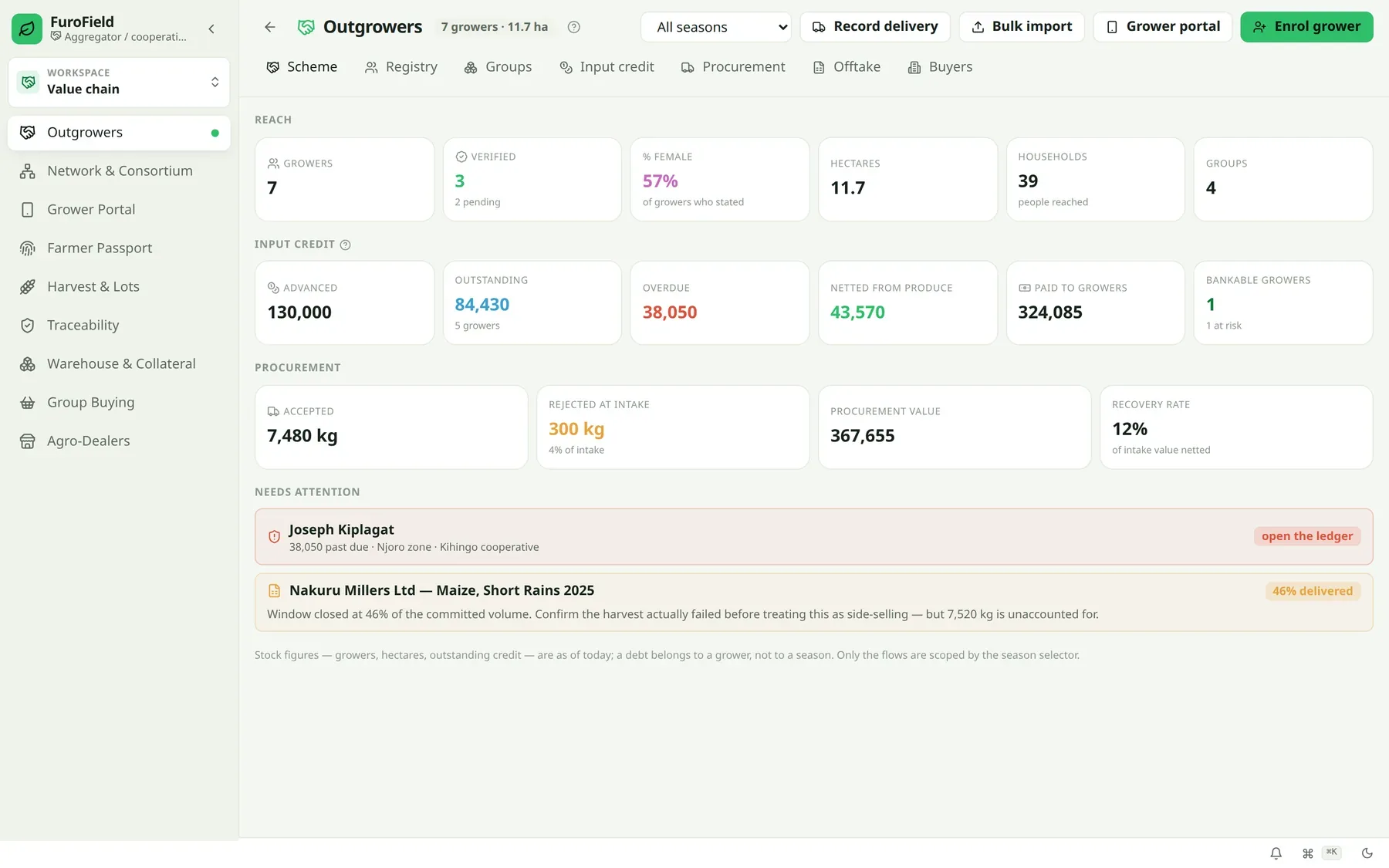
An aggregator sits in the tightest position in the chain. A buyer holds you to a volume and a delivery window. Growers hold you to an input advance and a fair price. You carry the recovery risk on inputs you handed out four months before anything comes back, and you carry the fulfilment risk if enough of that harvest walks past your depot to a trader paying cash at the gate.
FuroField makes the scheme itself the record. Growers are registered with identity, a GPS-mapped plot and a light verification ladder. Advances are issued against them and net automatically at delivery, oldest first. What was a seasonal reconciliation exercise becomes a position you can state on any given Tuesday.
You cannot manage a grower base you cannot enumerate
Enrolment happens on paper, at distance, by agents you see twice a month. By the time a list reaches the office it is weeks old and contains duplicates. Then a lender asks for a verified borrower list, or a buyer asks which plots the consignment came from, and the answer takes a fortnight to assemble.
- No current, single list of who is actually in the scheme this season
- Duplicate and ghost growers inflating input distribution and write-offs
- Advance balances nobody can state confidently before the season ends
- Side-selling invisible until the shortfall shows up against a buyer commitment
From first record to something you can act on
Enrol growers in the field
Field agents capture identity, household detail, national ID where required and a GPS-mapped plot. The local workspace continues without signal; shared reconnect and conflict handling are verified during the production pilot.
Organise the way you operate
Growers sit in cooperatives, associations, villages, zones or routes. The hierarchy is self-referencing, so it mirrors how your field teams are actually deployed rather than forcing a flat list.
Advance inputs against the register
Seed, fertiliser and chemicals go out as referenced advances tied to a named grower, with a value and a status — not as a distribution list that becomes a write-off in April.
Net at delivery, automatically
Intake value settles the oldest open advance first and the remainder becomes net payable. The scheme's credit position, delivered value and netted amount are current at any moment.
In detail
A grower register that survives staff turnover
Identity, plot geometry, area, household size and a unique reference per grower — institutional memory instead of thirty personal notebooks.
KYC-lite verification ladder
Unverified, pending, verified. Enrolment is never blocked, but credit and certification can demand a higher bar before an advance goes out.
Automatic FIFO recovery
Every grower is netted on the same rule, transparently, which removes both the reconciliation burden and the accusation of favouritism.
Per-grower ledger you can hand to a lender
Advances, deliveries and repayments per grower, exportable to an MFI or bank. For most smallholders it is the first formal credit history in their name.
Side-selling made measurable
An unrecovered advance stays outstanding and visible against a named grower rather than vanishing into a seasonal write-off, so leakage becomes a number instead of a suspicion.
Fulfilment against buyer commitments
Contracts hold committed volume and price; deliveries settle against them, so a gap against a buyer surfaces while the season can still close it.
Built for these operations
About aggregators & cooperatives
Do our outgrowers need smartphones or accounts?
No, and that is deliberate. Growers are records the scheme owns; field agents do the capture. A scheme that depends on every smallholder having a working handset and airtime will not enrol the growers who most need the credit.
Our agents work where there is no network for days. Does that break enrolment?
The app shell and local workspace continue without signal. Multi-day reconnect, conflict resolution and storage pressure are not yet a blanket promise; they are tested on the pilot's actual devices and routes.
Can we recover advances if a grower delivers to someone else?
FuroField does not chase the produce — it keeps the obligation attached to the grower. The advance stays outstanding and visible across seasons, which is what lets you make enrolment and advance decisions next season on evidence rather than goodwill.
How large a scheme does this handle?
The data model and hierarchy target large schemes. We validate representative grower counts, route filters and low-end device performance as an Enterprise acceptance gate rather than claiming scale from a small demo.
Related
Bring your fields online this season
Start free on up to 25 hectares — no card. Scale by the hectare as your operation grows.