Veja a época enquanto ela ainda é uma época.
Para o capital que financia a agricultura africana — e para as obrigações de reporte que vêm com ele.
Neste mercado, o crédito agrícola falha por informação muito antes de falhar por risco. O mutuário é, por definição, um processo fino: sem contas auditadas, sem garantia que um banco aceite, sem histórico de reembolso porque ninguém registou as últimas quatro épocas de adiantamentos de insumos que ele liquidou por inteiro. O resultado é que a diligência devida custa mais do que o empréstimo rende, e o capital vai para onde é mais fácil.
O FuroField não empresta nem avalia risco. É a camada de registo por baixo dos esquemas e das machambas que financia, para que as provas de que precisa — comportamento de reembolso por produtor, custo e margem por hectare, geometria das parcelas, cadastros de trabalhadores e tratamento de queixas — se acumulem como subproduto da operação, em vez de serem montadas para si na altura do relatório.
Não lhe vamos dizer que um histórico chega por si só. Uma pontuação de crédito feita de dados alternativos é descontada pela maioria dos financiadores, e com razão. O que torna uma época subscritível é o registo em conjunto com um comprador comprometido, uma economia que aguenta o cenário adverso, acompanhamento enquanto a cultura ainda está no terreno, e uma ordem de recuperação acordada antes de o capital se mexer. É para essa combinação que a plataforma está a caminhar.
Diligence and monitoring cost more than the ticket justifies
Every appraisal starts from zero because the borrower's operating history was never captured in a form anyone else can read. Monitoring is worse: portfolio reporting arrives quarterly, self-reported, in whatever shape each programme happens to use, and E&S reporting obligations land on organisations with no structured evidence to draw on.
- Thin-file borrowers with no repayment history and no acceptable collateral
- Appraisal cost per grower that swamps the margin on a small ticket
- Portfolio monitoring dependent on self-reported figures with no underlying record
- E&S safeguard obligations reported from narrative rather than from evidence
Do primeiro registo a algo sobre o qual pode agir
Finance schemes that keep records
The aggregator or grower runs FuroField for their own operational reasons. Registers, advances, deliveries and costs are captured because the business needs them, which is the only reason data stays honest.
Read the ledger rather than the narrative
Every advance carries a reference, a value and a status; every delivery nets against it. Repayment behaviour is a record with a history, not a claim in a proposal.
Monitor on operating data
Credit outstanding, delivered value, amount netted, cost and margin per hectare — current at any moment rather than reconstructed for a quarterly pack.
Draw safeguard evidence from operations
Worker register, grievance mechanism and community commitments are live capability. E&S reporting comes out of the same records rather than a parallel exercise at year end.
Em detalhe
Repayment history for thin-file borrowers
A per-grower ledger of advances, deliveries and settlements builds season on season — the asset that eventually makes a smallholder bankable at a sane rate.
Lower cost of diligence per grower
Verified identity, GPS plot and area for each borrower, held in a register rather than rebuilt from paper for every appraisal.
Per-hectare economics
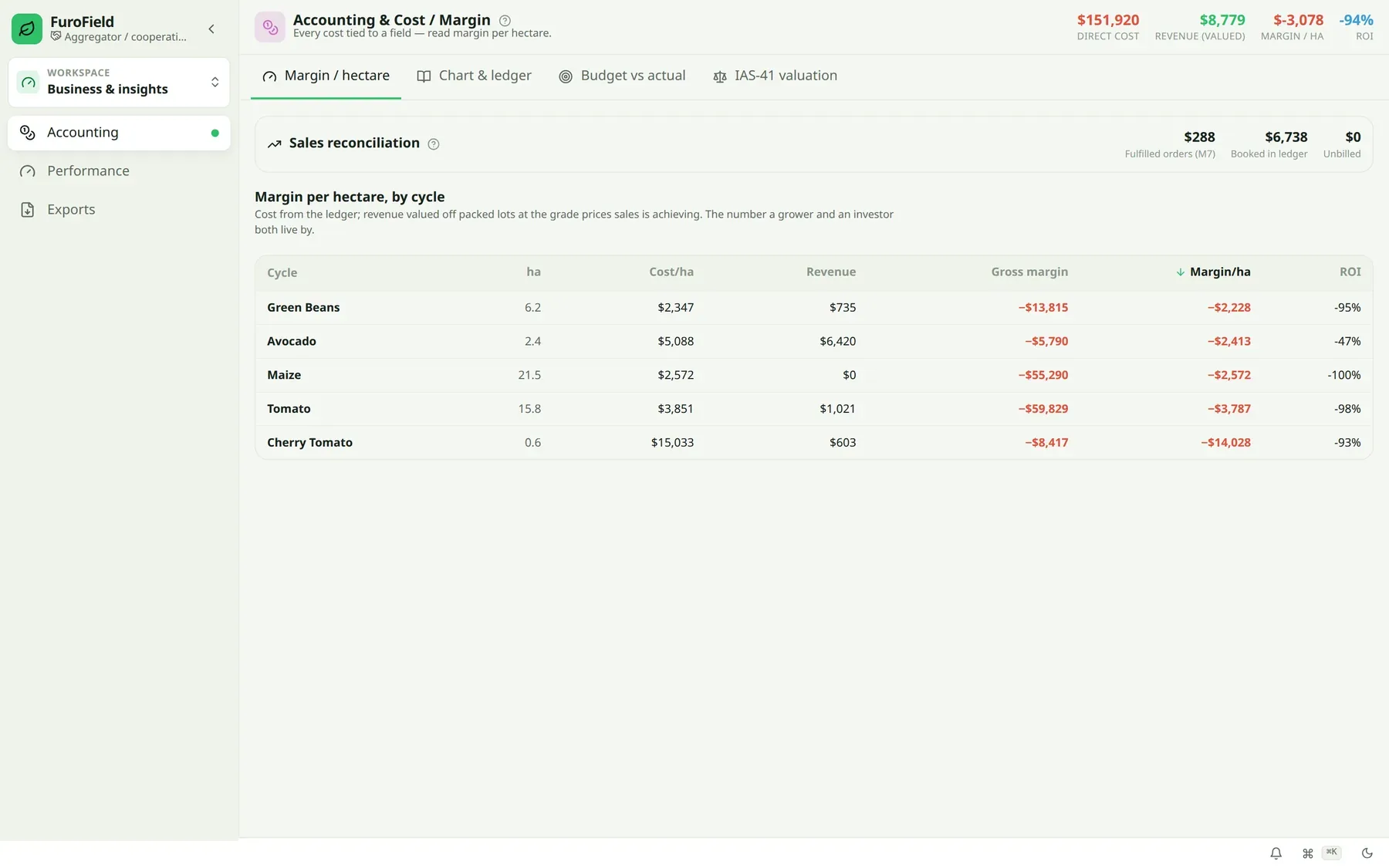
Cost and margin tied to measured area and to specific crop cycles, in the unit both an agronomist and a credit committee can argue about.
Portfolio view across programmes
Credit outstanding, delivered value and netted amount by scheme and by cohort, on a consistent basis across every programme you finance.
E&S safeguard evidence
Worker registers, a functioning grievance mechanism and community commitments — the material a development-finance E&S team asks for, kept as records rather than assertions.
Plot geometry for land-use screening
Boundaries captured at enrolment support deforestation due-diligence and land-use questions on the plots actually being financed.
A book you can see between reporting dates
If you hold a portfolio rather than a single position, the problem changes shape: you are a minority holder with a board seat, deliberately not running the company, and the accounts arrive a quarter after the season decided itself. A portfolio view built for that constraint is in design — the point is early enough to act, not prettier at year end.
Value across a mixed portfolio, not after a migration
Some of your investees run capable systems, some run a spreadsheet, some run nothing. A portfolio product that only works once every company migrates delivers in year three and is therefore never worth buying. Ours is designed to be useful across the book you actually have, and to get stronger where companies go deeper.
Impact evidence from operations, not from a survey round
Impact figures assembled from what the business already did, carrying their method and how firmly each is founded — so the annual reporting exercise your investees currently absorb becomes a by-product instead of a project.
Feito para estas operações
Sobre investidores e financiadores
Does FuroField score credit or make lending decisions?
No. It is the record layer. Scoring, pricing and the decision stay with you — what changes is that the inputs to that decision are operating records with a history behind them instead of a form filled in for the application.
How do we get data out for our own models and reporting?
Workspace exports exist for operational records. A borrower-controlled sharing mandate and read-only service-account/API access are portfolio-pilot capabilities, not generally available integrations today.
Why would a borrower let us see their operating data?
Because the alternative is a higher rate or no facility at all. Growers and aggregators adopt the platform for operational reasons first; sharing a verifiable ledger with a lender is what turns that record-keeping into cheaper capital.
How reliable is self-captured field data?
It is honest to say no platform makes field data true. What FuroField does is make it harder to be casually wrong — area derives from mapped geometry rather than being typed, advances and deliveries reconcile against each other, and every grower carries a unique reference so duplicates surface.
Can we see a repayment source before we disburse?
Not yet as an enforced gate — this is the honest answer. Offtake contracts, advances, netting and the per-grower ledger are live today, so the pieces exist. What is in design and named on the roadmap is recording a verified buyer commitment before inputs are issued, refusing a funded advance that has no demand or no plan reaching it, and settling deliveries through a waterfall stated at origination. We would rather show you the roadmap than imply it is already running.
Would you run a pilot with us?
That is exactly the shape we are looking for: one aggregator or exporter, one crop, one region, one committed buyer, one lender, roughly 200 to 500 growers, one full season — measured against your own historical cohort on approval cost and turnaround, delivery against contract, side-selling, default rate, days from delivery to farmer payment, and the cost of producing your own reporting. It is scoped as a portfolio outcome, not a software licence.
We hold a portfolio, not a single position. Does that change anything?
It changes the problem entirely, and we treat it as a distinct one. A minority holder with a board seat is deliberately not running the company, so the question is not how to control an investee — it is how to have any line of sight between reporting dates, across a book where every company keeps records differently. That view is in design rather than shipped, and it is built to be worth something across the portfolio you have today rather than only after every investee has migrated onto us.
Would our investees see what we see?
Yes, and before you do — this is a design commitment rather than a setting. An investee can see exactly what a mandate would release, and can pause or withdraw it. Asymmetric visibility is surveillance, and beyond the ethics it is self-defeating: a company that experiences reporting purely as homework quietly stops feeding it, and the whole book decays to whatever people can be bothered to type in. Reporting that the investee also uses as its own board pack is the only kind that stays accurate.
Ponha os seus talhões no mapa esta época
Comece grátis até 25 hectares — sem cartão. Cresça ao hectare à medida que a operação cresce.